ENGINEERING MATERIAL
Nylon (Polyamide)
A workhorse of the engineering world. Discover why Nylon's unique combination of strength, durability, and flexibility makes it a top choice for functional parts across all manufacturing processes.

The Go-To Material for Functional Components
Nylon is a family of synthetic engineering thermoplastics known as polyamides (PA). It is valued for its excellent mechanical properties, offering high strength, toughness, and resistance to wear, impact, and chemicals. Its low coefficient of friction also makes it ideal for moving parts.
High Strength & Toughness
Nylon can withstand significant mechanical stress and repeated impacts without fracturing, making it more durable than common plastics like ABS or PLA.
Excellent Wear Resistance
With its low-friction surface, Nylon is perfectly suited for applications involving sliding or rotating contact, such as gears, bearings, and living hinges.
Good Chemical Resistance
Nylon is resistant to a wide range of oils, fuels, and organic solvents, making it a reliable choice for automotive and industrial applications.
Using Nylon at HyProto
We leverage Nylon across our key manufacturing services to produce parts for any stage of your product lifecycle.
Nylon for SLS 3D Printing
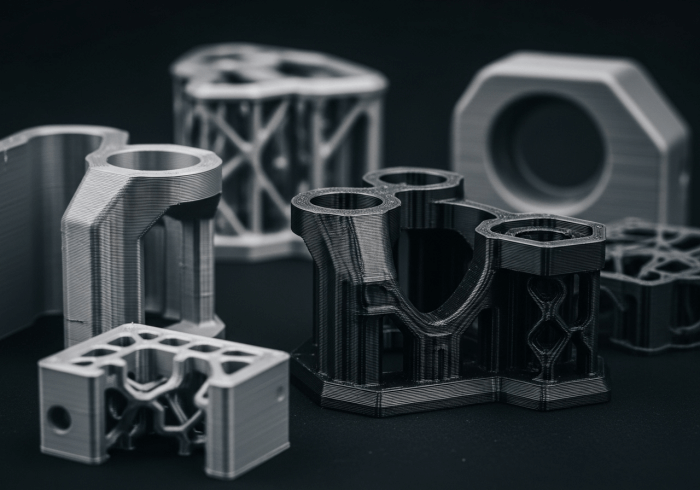
Nylon, particularly PA 11 and PA 12, is the primary material for Selective Laser Sintering (SLS). This process produces strong, functional parts with a slightly grainy surface finish. Because it requires no support structures, SLS allows for incredible design freedom, making it perfect for complex assemblies, internal lattices, and parts with living hinges.
Nylon for CNC Machining
We machine Nylon from solid stock (rods and sheets). Machined Nylon parts have excellent dimensional accuracy and a smooth surface finish. This method is ideal when tighter tolerances are required than 3D printing can offer, or for creating parts like high-precision bushings and insulators.
Nylon Plastic FAQ
Does Nylon absorb moisture?
Yes, Nylon is hygroscopic, meaning it will absorb moisture from the air. This can cause slight changes in dimensions and a decrease in stiffness, but it also increases its impact strength and toughness. This should be considered for parts used in humid environments with very tight tolerance requirements.
What is "Glass-Filled" Nylon?
Glass-filled Nylon is a composite material where small glass fibers are mixed into the base Nylon resin. This significantly increases the material's stiffness, strength, and heat resistance compared to standard Nylon, but it also makes it more brittle.
What is the difference between Nylon 12 and Nylon 66?
Nylon 12 (PA12), commonly used in SLS 3D printing, has lower moisture absorption and better dimensional stability. Nylon 66 (PA66), often used in injection molding and machining, generally has a higher melting point and greater stiffness.