ENGINEERING MATERIAL
POM / Acetal (Delrin®)
The premier material for high-performance mechanical parts. Discover why Acetal's low friction, high stiffness, and incredible machinability make it a top choice for precision components.
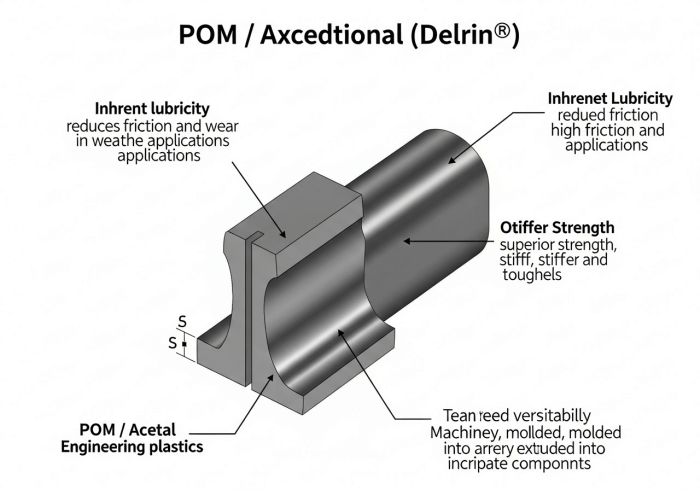
The Engineer's Choice for Precision and Stability
Polyoxymethylene (POM), commonly known by its trade names like Delrin® (a homopolymer) or Celcon® (a copolymer), is a semi-crystalline engineering thermoplastic. It is prized for its exceptional properties that bridge the gap between high-performance plastics and metals.
High Stiffness & Strength
POM is very rigid and strong, maintaining its properties under load and over a wide temperature range. It resists creep, which is the tendency to slowly deform over time under constant stress.
Low Friction & High Wear Resistance
With a naturally slippery, low-friction surface, POM is ideal for sliding and moving parts. It exhibits excellent wear resistance, often outlasting metals in abrasive applications without the need for lubrication.
Excellent Dimensional Stability
POM has very low moisture absorption. This means its dimensions will not change significantly in humid environments, making it a reliable choice for high-precision parts that require tight tolerances.
CNC Machining POM
POM is one of the most machinable plastics available. It cuts cleanly, forming well-broken chips and allowing for high-speed machining operations. This results in parts with an excellent surface finish and very high dimensional accuracy, often straight off the machine.
Because of its stability and predictability during machining, it's the go-to material for creating precision jigs, fixtures, gears, bushings, and any mechanical component where tight tolerances are critical.

Ideal Applications for POM (Delrin®)
Anywhere you need a strong, stable, and low-friction component, POM is a leading candidate.
Gears & Sprockets
Bearings & Bushings
Jigs & Fixtures
Snaps & Buckles
Pump & Valve Parts
Electrical Insulators
Medical Device Components
Automotive Switches
POM (Delrin®) FAQ
What is the difference between Delrin® (Homopolymer) and Acetal Copolymer?
Delrin® (POM-H) generally has slightly better mechanical properties, including higher stiffness, tensile strength, and hardness. Acetal Copolymer (POM-C) has better chemical resistance, particularly to hot water and high-pH solutions, and is less prone to centerline porosity in thick sections. For most mechanical applications, they are largely interchangeable.
Is POM difficult to bond or glue?
Yes, similar to Polypropylene, POM has a low surface energy and is chemically resistant, making it very difficult to bond with common adhesives. It requires special surface preparation and industrial adhesives like cyanoacrylates (with a primer) or epoxies designed for low surface energy plastics.
Is Delrin® food safe?
Many grades of natural (unpigmented) Acetal Copolymer and Delrin® are compliant with FDA, NSF, and other food contact regulations. If your application requires food-grade compliance, please specify this requirement so we can ensure the correct material grade is sourced.