3D PRINTING TECHNOLOGY
Multi Jet Fusion (MJF)
The definitive technology for speed and performance in polymer 3D printing. MJF produces strong, accurate, and repeatable parts, moving seamlessly from functional prototyping to end-use production.
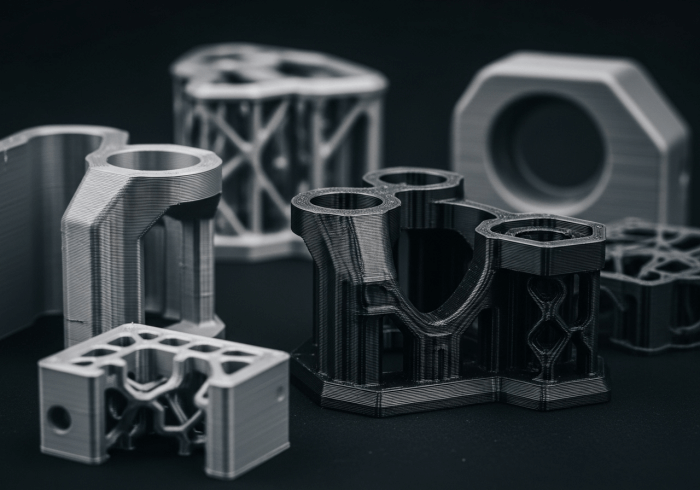
The Process: Printing with Agents and Energy
Multi Jet Fusion is a powder bed fusion technology developed by HP. Unlike SLS which uses a laser, MJF uses an inkjet array to selectively apply liquid agents to a bed of polymer powder. A fusing agent is jetted where the material needs to solidify, and a detailing agent is jetted around the edges to create sharp, crisp surfaces.
After the agents are applied, an infrared energy source passes over the entire bed. The fusing agent absorbs this energy, melting the powder beneath it into a solid layer. The detailing agent helps to scatter the heat, creating a sharp boundary. The process repeats layer by layer, with the unsintered powder providing support for the part. This method allows for an entire layer to be fused at once, making it significantly faster than laser-based systems.
Why Choose Multi Jet Fusion?
Exceptional Speed
By fusing an entire layer at once, MJF offers industry-leading printing speeds, enabling faster turnaround times for both single parts and large batches.
Isotropic Properties
MJF parts exhibit nearly identical mechanical properties in all three axes (X, Y, and Z). This makes them much stronger and more predictable for functional applications than FDM parts.
Fine Feature Detail
The use of a detailing agent allows MJF to produce parts with higher resolution and sharper edge definition than comparable powder bed fusion technologies like SLS.
MJF Technology FAQ
How does MJF compare to SLS?
Both produce strong nylon parts. MJF is generally faster and can produce finer details. SLS parts are typically white and can be dyed more easily, while MJF parts are naturally a consistent gray or black. For most functional applications, they are highly comparable, but MJF often has a slight edge in speed and feature resolution.
What materials are available for MJF?
The most common and versatile material is Nylon PA 12, which offers excellent all-around mechanical properties. Other materials include PA 11 for higher ductility, Glass-Filled PA 12 for added stiffness, and flexible TPU (Thermoplastic Polyurethane).
Can MJF parts be post-processed?
Yes. MJF parts have a slightly grainy surface finish but respond very well to post-processing. They can be dyed black for a uniform, deep color. They can also undergo vapor smoothing processes to create a sealed, semi-glossy surface that looks and feels like an injection-molded part.