3D PRINTING TECHNOLOGY
Selective Laser Sintering (SLS)
The workhorse for functional prototyping. SLS technology produces tough, production-grade nylon parts with a design freedom that is unmatched by other processes.
The Process: Sintering Powder with a Laser
Selective Laser Sintering is a Powder Bed Fusion technology. The process takes place in a chamber heated to just below the polymer's melting point. A roller spreads a very thin layer of fine nylon powder across a build platform. A powerful CO2 laser then scans the cross-section of the 3D model, selectively heating and fusing (sintering) the powder particles together into a solid layer.
The platform then lowers by one layer thickness, a new layer of powder is applied, and the process repeats. The unsintered powder in the bed provides complete support for the part, eliminating the need for any dedicated support structures.

Why Designers Choose SLS
No Support Structures Needed
This is the key advantage of SLS. It allows for complete design freedom, enabling the creation of complex internal geometries, interlocking parts, and assemblies printed in a single piece.
Excellent Mechanical Properties
SLS parts made from materials like Nylon 12 are tough, durable, and have good impact and chemical resistance, making them suitable for rigorous functional testing and even end-use applications.
High Production Efficiency
Because no supports are needed, the entire build volume can be tightly packed ("nested") with many different parts, making SLS a very efficient process for producing low-volume batches of custom components.
Ideal Applications for SLS
- Functional Prototypes: The number one use for SLS is creating tough prototypes for real-world testing.
- Complex Enclosures: Create housings with integrated clips, vents, and mounting features in a single part.
- Living Hinges & Snap-Fits: The durability and slight flexibility of Nylon make it perfect for testing these features.
- Low-Volume Production: An economical way to produce batches of 50-500 end-use parts without any tooling investment.
Laser Sintering FAQ
What is the surface finish of an SLS part?
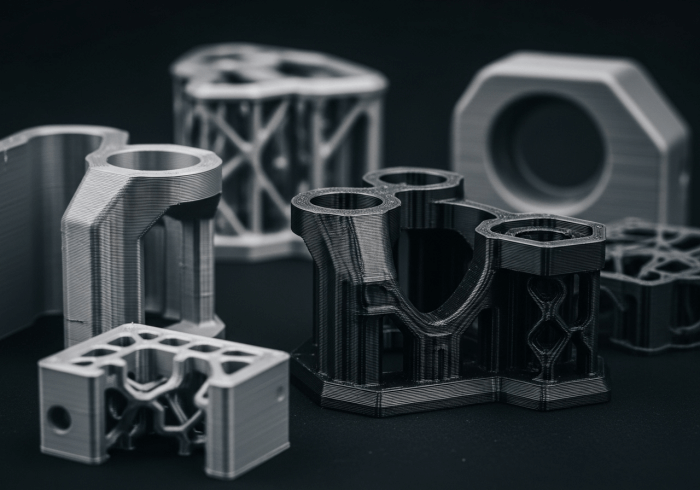
As-printed, SLS parts have a grainy, matte texture, similar to a sugar cube. This surface can be left as-is for functional parts or can be post-processed via bead blasting for a more uniform satin finish, or dyed black for a professional look.
How accurate are SLS parts?
SLS offers good accuracy, typically within ±0.3 mm for most dimensions. It is suitable for most functional prototyping needs, but for features requiring very high precision (like bearing bores), secondary CNC machining is recommended.
What materials can be used with SLS?
The most common material by far is Nylon, particularly PA 12 for its all-around performance and PA 11 for its higher flexibility. We also offer filled grades, such as Glass-Filled Nylon for increased stiffness and heat resistance, and Aluminum-Filled Nylon (Alumide) for a metallic appearance.